
Every SolidBuild kit ships with solid tongue-and-groove roof boards. The waterproof layer on top (shingles, a membrane, metal) is yours to choose and to fit. This guide tells you the pitch of your model, which coverings fit that pitch, what they cost, and how to put them on.
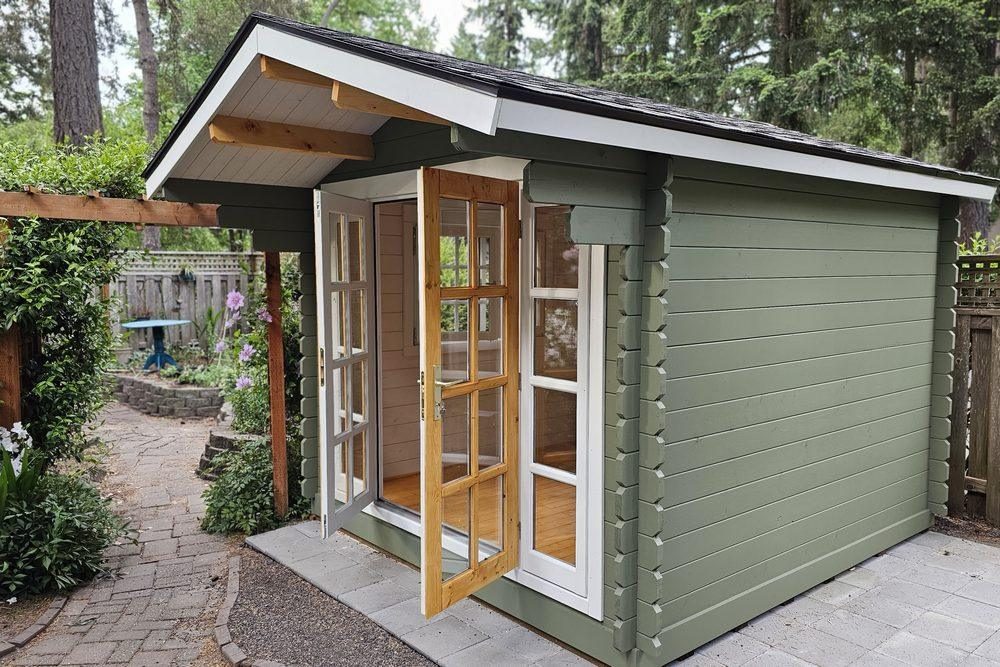
Pitches are the published figures, rounded from the current drawings (September 2026): the gable and 1:12 models to the whole inch, Moderna and Solana to the nearest half. Building-code figures are the International Residential Code (2021/2024); your local code may add to them. Prices are guide figures from our project cost estimator and September 2026 retail, check your supplier. The instructions printed on the product you buy take precedence over anything here.
In a hurry?
The short version
Every SolidBuild roof has one of four pitches. Find yours; the rest of the guide follows from it. Nothing for the roof is in the kit except the boards: underlayment, drip edge and the covering are bought locally.
4:12 · gable
Standard shingle roof
You've got the pick of everything. Shingles the standard way (one layer of felt), cedar, metal, roll roofing, clear panels. These three sit right at the 4:12 line, so for the best protection lay shingles over an ice-and-water shield or double felt.
About $230–390 in materials with shingles and drip edge; one dry day for two people.
3:12 · gable
Shingles over two layers
Shingles work, over two layers of felt or an ice-and-water membrane, the rule for every roof between 2:12 and 4:12. Cedar with less of each shingle showing, metal, roll roofing and clear panels all fit too.
About $340–620 in materials with shingles, drip edge and the underlayment (Dakota up to $850); one dry day.
1:12 · low slope
No shingles
Membrane, roll or metal. EPDM or TPO/PVC, a self-adhered 2-ply or Peel & Seal (over a plywood layer), roll roofing rated 1:12, screw-down metal with every overlap sealed, standing seam, or clear panels rated 1:12.
About $620–680 in materials with EPDM and drip edge (Washington about $1,030); half a day.
½:12 · nearly flat
Membrane roof
EPDM or TPO/PVC is the covering made for this pitch; a self-adhered 2-ply or Peel & Seal over a plywood layer also fits, and customers have used screw-down metal with every overlap sealed. No shingles, roll roofing or clear panels.
About $460–570 in materials with EPDM and drip edge; half a day.
The words on the wrapper
Glossary
Pitch: how far the roof climbs for every 12 inches it runs, written 4:12. You'll also see it written as inches per foot, which means the same thing: ½ in per foot is ½:12.
Eave: the low edge of the roof.
Rake: the sloping edge at a gable end.
Ridge: the top.
Fascia: the trim board along the roof edge (in the kit).
Drip edge: L-shaped metal strip along the edges.
Underlayment: the layer that goes between the roof boards and the covering: felt, a synthetic sheet, or a stick-down ice-and-water membrane.
Overlap: how far one sheet, shingle or panel covers the one below it. Roofing products call this a "lap", so you'll see side laps and end laps on the wrapper.
Starter strip: the cut-down first row of shingles.
Exposure: how much of each shingle shows.
Square: roofer's shorthand for 100 sq ft of roof.
Fall: the gentle slope that drains a "flat" roof.
Termination bar: the metal strip that clamps the edge of a membrane down.
Butyl tape: sticky sealing tape that goes between two metal panels where they overlap.
Stitch screws: short screws that pin that overlap together.
Closure strips: shaped foam fillers that plug the gaps under the ribs at the top and bottom of metal or clear panels.
Section 1
Know your roof: the pitch
Roof pitch is how many inches the roof rises for every 12 inches it runs. A 4:12 roof climbs 4 inches over a foot; a ½:12 roof climbs half an inch. Roofing products are all rated in this rise-per-12 form, so it's the number to have in your head when you shop.
| Model | Roof | Pitch | Roof area |
|---|---|---|---|
| Shiba | gable | 4:12 | 76 sq ft |
| Myrtle | gable | 4:12 | 138 sq ft |
| Whales | gable | 4:12 | 138 sq ft |
| Gardener | gable | 3:12 | 109 sq ft |
| Optima | gable | 3:12 | 174 sq ft |
| Bristhol | gable | 3:12 | 176 sq ft |
| Aspen | gable | 3:12 | 133 sq ft |
| Dakota | gable | 3:12 | 250 sq ft |
| Astoria | single slope | 1:12 | 185 sq ft |
| California | single slope | 1:12 | 166 sq ft |
| Washington | single slope | 1:12 | 285 sq ft |
| Moderna | single slope | ½:12 | 122 sq ft |
| Solana | single slope | ½:12 | 153 sq ft |
Both halves of a gable roof have the same pitch. The "flat" modern roofs are not flat: each has a small fall so water drains toward one edge, ½:12 is a 5-inch drop across a 10-foot roof. Moderna and Solana: ½:12 is the published figure and the one this guide uses throughout; the current production drawings measure a little under it, a Moderna falls 3⅞ in across its 11 ft ½ in roof, about ⅜:12. On these two, treat every ½:12 manufacturer's recommended minimum here as one you are sitting on rather than clearing: the membranes, rated to ¼:12, are the covering with room to spare, and everything else on them carries a condition.
Inches of rise per 12 inches of run. The five modern models are under 2:12; five gable models are in the two-layer band; three sit at the 4:12 line.
Section 2
Why the pitch decides the roofing
Shingles are small overlapping pieces. They keep water out by gravity: rain hits a shingle, runs down onto the one below, and off the roof. The flatter the roof, the slower the water moves, and wind can push it back up under the overlaps. Below a certain pitch, shingles simply stop working, which is why the building code and every shingle manufacturer set the same limits:
- Under 2:12: no asphalt shingles at all. Water sits, and a shingled roof will leak. This is the whole modern line: Moderna, Solana, Washington, Astoria and California.
- 2:12 up to 4:12: shingles are allowed, but only over "double underlayment": two layers of roofing felt, overlapped so that every spot on the roof is covered twice, or one stick-down ice-and-water membrane over the whole roof instead. That is Gardener, Optima, Bristhol, Aspen and Dakota.
- 4:12 and steeper: standard installation, one layer of underlayment. That's Shiba, Myrtle and Whales. They sit exactly at 4:12, the lowest pitch that still counts as standard, so if the budget allows we'd still use the two-layer method on them.
Membranes (EPDM rubber, TPO/PVC) work the opposite way: one big sheet, glued or welded together, with no overlaps for water to creep back up. They are rated down to ¼:12, which is why they are the answer for the flattest roofs. Metal panels and roll roofing sit in between, each with its own minimum; the table in the next section has all of them.
What this does to your warranty. GAF, Owens Corning, Malarkey and TAMKO write no slope limit into their shingle warranties; they require their instructions (the two layers, or the membrane over the whole roof, under 4:12) to be followed. CertainTeed writes "2:12 or greater" into its warranty and accepts the two felt layers only where snow and ice are not expected. Atlas's instructions make following them a condition of its warranty. IKO is stricter: its full term applies from 4:12 (Shiba, Myrtle, Whales); on a 3:12 roof (Gardener, Optima, Bristhol, Aspen, Dakota) you keep the regular warranty by following the low-slope method on the wrapper, and IKO says some of its shingles are not suitable below 4:12 at all. Read the wrapper before you buy; the low-slope method is printed on it.
Does the code apply to a shed? Yes. Many towns do not require a permit for a one-storey shed up to 200 sq ft (some keep the older 120 sq ft limit), but "no permit needed" is not "no rules apply", and the same rules are the ones your roofing supplier and your warranty follow anyway. And this is a small roof, if you ever do need to put something right, it's a cheap fix. That is why this guide gives you every option that is rated for your pitch, with the manufacturer's condition next to it, and lets you choose.
Section 3
Which roofing fits which shed
Green means the covering is rated for the pitch. Amber means it works with a condition, read the note. Red means the product's own minimum is steeper than the roof: don't.
| Covering | Minimum pitch | 4:12 · Shiba, Myrtle, Whales | 3:12 · Gardener, Optima, Bristhol, Aspen, Dakota | 1:12 · Astoria, California, Washington | ½:12 · Moderna, Solana |
|---|---|---|---|---|---|
| Asphalt shingles | 2:12; two layers under 4:12 | Yes, standard, one layer of felt (two layers or ice-and-water for the best protection) | Yes, two layers of felt or an ice-and-water membrane under them (CertainTeed shingles in snow country: the membrane) | No | No |
| Cedar shingles (sawn) and shakes (split) | Shingles 3:12 · shakes 4:12 | Yes; shakes too | Yes, with less of each shingle showing, as the manufacturer sets out (about 30 % more shingles); no shakes | No | No |
| Mineral-surfaced roll roofing, single layer | 1:12 by code; the common exposed-nail roll (GAF Mineral Guard) 2:12 | Yes | Yes | Yes with a roll whose sheet says 1:12, or the double-coverage method, where the nails end up hidden under the next sheet (the "concealed-nail" method: 36-in sheet, 17 in showing, every overlap glued with roofing cement); the ordinary roll needs 2:12 | No |
| Self-adhered 2-ply roll system (GAF Liberty; CertainTeed Flintlastic SA) | ¼:12 by code; GAF Liberty ½:12 | Yes, over a primed plywood or OSB layer, or a nailed base sheet (not straight onto the roof boards); nail the top edge of each cap sheet before the next one covers it, as this roof is steeper than 1:12 | Yes, same rule about the plywood; nail the top edge of each cap sheet before the next covers it | Yes, same rule about the plywood | Yes, same rule about the plywood; right at GAF Liberty's recommended minimum of ½:12 |
| MFM Peel & Seal | ½:12 | Yes, over a primed plywood or OSB layer; MFM doesn't allow it straight on tongue-and-groove boards | Yes, same rule about the plywood | Yes, same rule about the plywood | Yes, same rule about the plywood; right at MFM's recommended minimum of ½:12 |
| EPDM rubber, TPO or PVC membrane | ¼:12 | Yes | Yes | Yes | Yes, the covering made for this pitch |
| Metal panels, screw-down (exposed fastener) | 3:12 plain; ½:12 with the overlaps sealed, by code. Panel manufacturers: R-panel / PBR types 1:12 with the overlaps sealed and screwed; the thin rib panel sold by the sheet at hardware stores, 3:12 | Yes, any panel | Yes, any panel, these sit exactly at 3:12, so a $10 roll of sealing tape (butyl tape) in the side overlaps is worth it | Yes, a panel rated 1:12 (R-panel / PBR type), sealing tape (butyl tape) in every side overlap and short screws through it (stitch screws); not the thin hardware-store rib panel | Customers have done it and it works: seal every side overlap and screw through it. Go in knowing you're below the 1:12 the panel manufacturers recommend, and that the rubber washers under the screws are the weak point, look them over every couple of years and replace any that have cracked |
| Metal, standing seam | ¼:12 by code; clip-together (snap-lock) panels 1:12 to 3:12 depending on the panel; panels crimped shut with a seaming tool (mechanically seamed), ½:12 | Yes | Yes (a clip-together panel rated for 3:12 or less) | Yes, a clip-together panel whose label says 1:12, over a solid surface (some want 3:12), or the crimped-seam kind | Only the crimped-seam kind, which is a roofer's job |
| Clear polycarbonate / PVC panels (no underlayment) | 1:12 (Onduline Tuftex) to 1½:12 (Palram Suntuf, Palruf) | Yes | Yes | Yes with a product rated 1:12 (Tuftex); Suntuf and Palruf want 1½:12; in heavy-snow areas Tuftex asks for up to 3:12 | No |
Minimums from the International Residential Code (R905) and the manufacturers' installation instructions (sources in section 12). Where a manufacturer is stricter than the code, its condition is written into the cell, you are buying their product and their warranty.
Section 4
What it costs, model by model
Guide figures at our calculator's 2026 rates: roof area plus a 10 % waste allowance, times the material rate. The "usual choice" is shingles on the gable models and EPDM on the modern ones. The underlayment column is the extra for the two-layer method under shingles, a second layer of felt at about $0.15/sq ft, or an ice-and-water membrane at about $0.60/sq ft (budget rolls; premium brands about double); it applies on the 3:12 models and is optional on the 4:12 ones. Drip edge is $1.50 a foot around the roof. Roofing nails, adhesive, primer and tools are on top.
| Model | Pitch | Roof area | Buy (with 10 % waste) | Usual choice | Material | Second felt layer or ice-and-water | Drip edge |
|---|---|---|---|---|---|---|---|
| Shiba | 4:12 | 76 sq ft | 84 sq ft | asphalt shingles | $185 | optional +$13 / +$50 | $48 |
| Myrtle | 4:12 | 138 sq ft | 152 sq ft | asphalt shingles | $334 | optional +$23 / +$91 | $60 |
| Whales | 4:12 | 138 sq ft | 152 sq ft | asphalt shingles | $334 | optional +$23 / +$91 | $60 |
| Gardener | 3:12 | 109 sq ft | 120 sq ft | asphalt shingles | $264 | +$18 / +$72 | $60 |
| Aspen | 3:12 | 133 sq ft | 146 sq ft | asphalt shingles | $321 | +$22 / +$88 | $66 |
| Optima | 3:12 | 174 sq ft | 191 sq ft | asphalt shingles | $420 | +$29 / +$115 | $72 |
| Bristhol | 3:12 | 176 sq ft | 194 sq ft | asphalt shingles | $427 | +$29 / +$116 | $72 |
| Dakota | 3:12 | 250 sq ft | 275 sq ft | asphalt shingles | $605 | +$41 / +$165 | $84 |
| Astoria | 1:12 | 185 sq ft | 204 sq ft | EPDM membrane | $612 | n/a | $72 |
| California | 1:12 | 166 sq ft | 183 sq ft | EPDM membrane | $549 | n/a | $72 |
| Washington | 1:12 | 285 sq ft | 314 sq ft | EPDM membrane | $942 | n/a | $90 |
| Moderna | ½:12 | 122 sq ft | 134 sq ft | EPDM membrane | $402 | n/a | $60 |
| Solana | ½:12 | 153 sq ft | 168 sq ft | EPDM membrane | $504 | n/a | $69 |
Shingles at the calculator's "Felt Paper + Asphalt Shingles" rate of $2.20/sq ft (one felt layer implied), EPDM at its $3.00/sq ft rate, all-in guide rates; the calculator does not itemise nails or adhesive. For any other combination, metal, cedar, clear panels, insulation, labour hours, use the project cost estimator, which prices every option on your model's own roof area.
Section 5
The coverings, one by one
Guide prices are the per-square-foot rates the calculator uses (material, 2026). Lifespans are typical for the material; the manufacturer's warranty is the number that counts.
Asphalt shingles
The familiar choice, and the easiest to match to the house. They come in bundles, usually three bundles to 100 sq ft, the bundle tells you what it covers. They nail down over an underlayment. Three-tab shingles are cheapest; architectural (laminated) shingles are thicker and last longer. On the 3:12 models there's one rule that really matters: two layers of felt underneath, or an ice-and-water membrane (section 6). On the 4:12 models one layer is all the code asks for, we'd still use two, but that's our advice, not a rule.
About the nails. The code and the shingle manufacturers all want the nail to bite at least ¾ in into the roof boards, or go right through them. Our roof boards are ¾ in tongue-and-groove spruce (if another page tells you ⅝ in, just measure a board). For three-tab shingles, 1 in nails are what you need. Architectural shingles are thicker, so do the math before you buy: two layers of shingle, since every nail goes through the overlap, plus the ¾ in of the boards. If that adds up to less than your nail is long, the point comes out the other side, lay a sheet of OSB or plywood over the boards first and nail into that with 1¼ in roofing nails. The only downside is the added weight, which comes out of your snow-load allowance.
- Fits
- 4:12 and 3:12 models
- Minimum
- 2:12; two layers under 4:12
- Guide price
- $2.20 / sq ft (calculator rate, felt + shingles)
- Lifespan
- 20–30 years
- DIY
- Easy; a day for two people
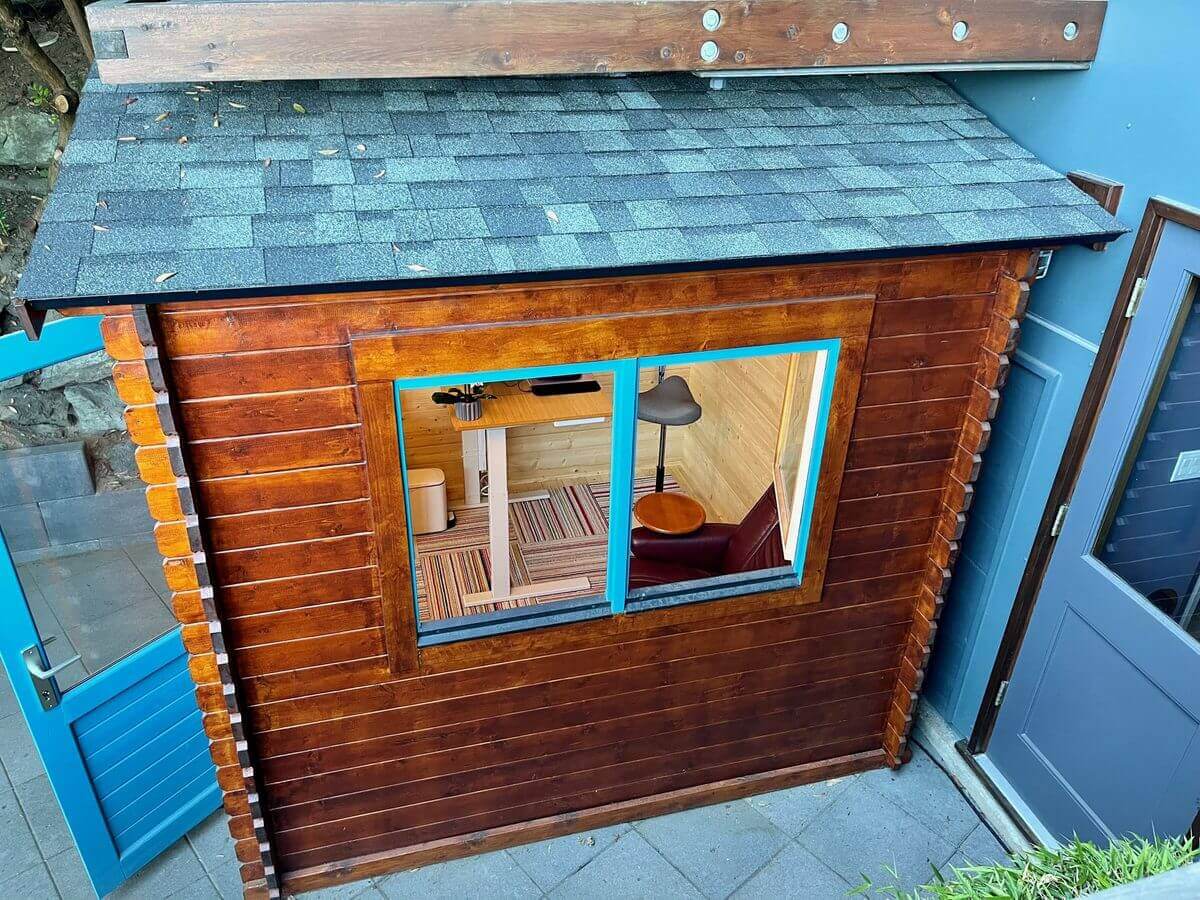
Cedar shingles and shakes
The premium natural look, and the one place where two products that sound the same behave differently.
Shingles are sawn; shakes are split. A cedar shingle is sawn on both faces, so it is thin (about ⅜–½ in at the butt), smooth and an even thickness, and it lies flat against the one below it. A cedar shake is split from the log, so it is thicker (½–¾ in or more), rough on the face and never quite flat. That texture is what people buy shakes for, and it is also why they need a steeper roof: the little gaps under a wavy shake let wind-driven rain work its way back up, which a flat-lying shingle does not allow.
So on the 3:12 models (Gardener, Optima, Bristhol, Aspen and Dakota) you can use cedar shingles, but not shakes. Wood shingles are rated from 3:12, and between 3:12 and 4:12 you lay them with less of each shingle showing, which takes roughly 30 % more shingles; the Cedar Shake & Shingle Bureau also recommends the pressure-treated kind on those pitches. Shakes need 4:12, so they belong on Shiba, Myrtle and Whales, which can take either.
- Fits
- Shingles: 4:12 (standard) and 3:12 (less of each shingle showing) · Shakes: 4:12 only
- Minimum
- 3:12 sawn shingles · 4:12 split shakes
- Guide price
- $6.00 / sq ft, plus ~30 % when less of each shingle shows
- Lifespan
- 30–50 years
- DIY
- Moderate
Roll roofing and self-adhered 2-ply systems
Roll roofing is shingle material in a roll. The ordinary mineral-surfaced roll (GAF Mineral Guard and the like) nails down with each strip overlapping the one below. The code allows roll roofing from 1:12, but this common product says 2:12 on its wrapper, so on the 1:12 models buy a roll whose label says 1:12, or use the double-coverage method: 36-in strips with only 17 in showing, every overlap glued with roofing cement, and the nails hidden under the next strip. Suppliers call this the concealed-nail method.
The modern version is a self-adhered two-ply system, a base sheet and a granulated cap sheet that stick down without a torch (GAF Liberty, CertainTeed Flintlastic SA). GAF rates Liberty from ½:12 and wants it on primed plywood, so over our plank boards you'll first put down a nailed base sheet or a sheet of plywood or OSB, primed the way the kit tells you. Set the end overlaps in a bed of the manufacturer's cement, press every overlap down with a weighted roller, and on anything steeper than 1:12 (that's the gable models) nail the top edge of each cap sheet before the next one covers it. Work between 45 and 95 °F. It's a good budget choice on the 1:12 models; on Moderna and Solana you're right at Liberty's recommended minimum of ½:12.
- Fits
- roll: 4:12, 3:12, 1:12 (rated roll) · 2-ply: every model, over plywood or a base sheet
- Minimum
- 1:12 roll · ½:12 two-ply
- Guide price
- $1.65 / sq ft (2-ply: cap sheet over a nailed base sheet)
- Lifespan
- about 20 years
- DIY
- Easy to moderate
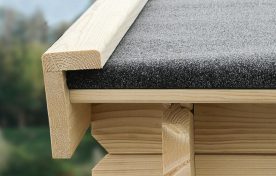
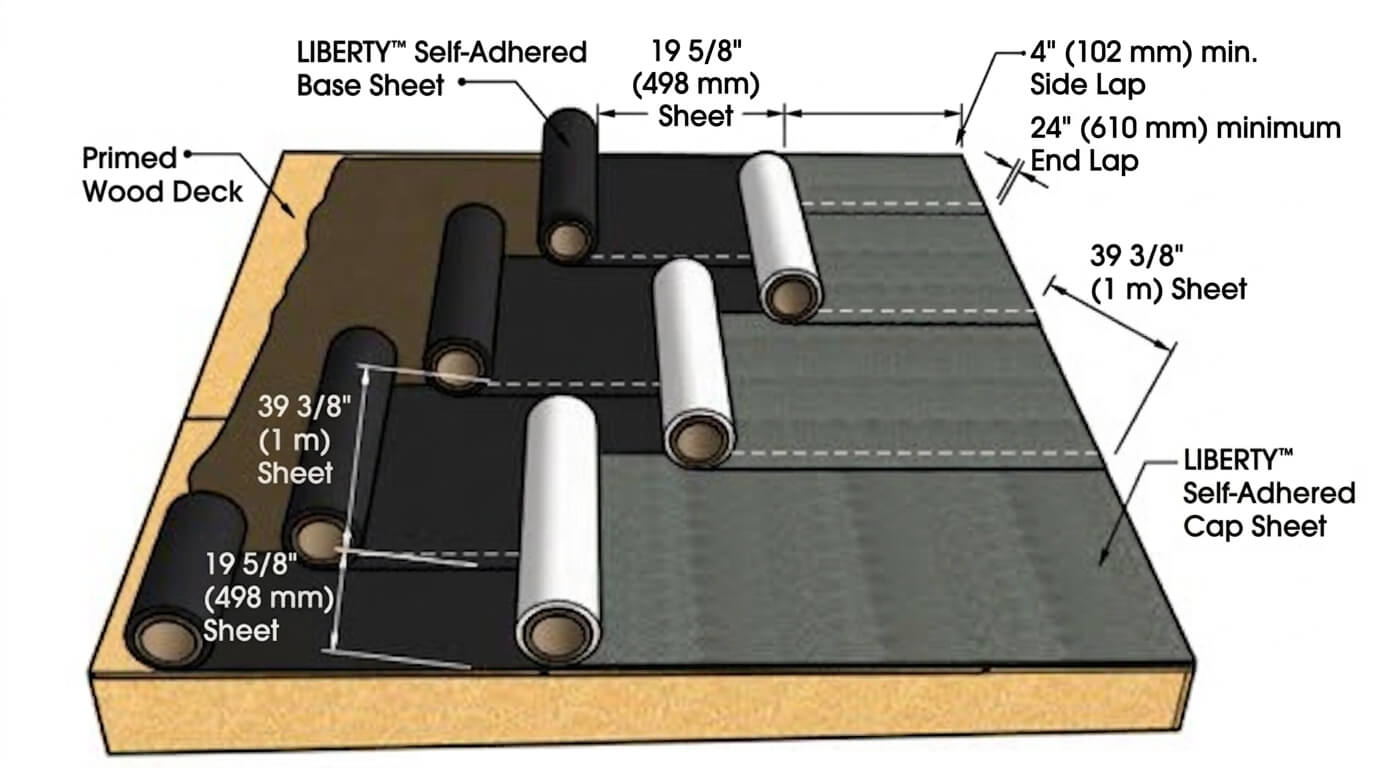
MFM Peel & Seal
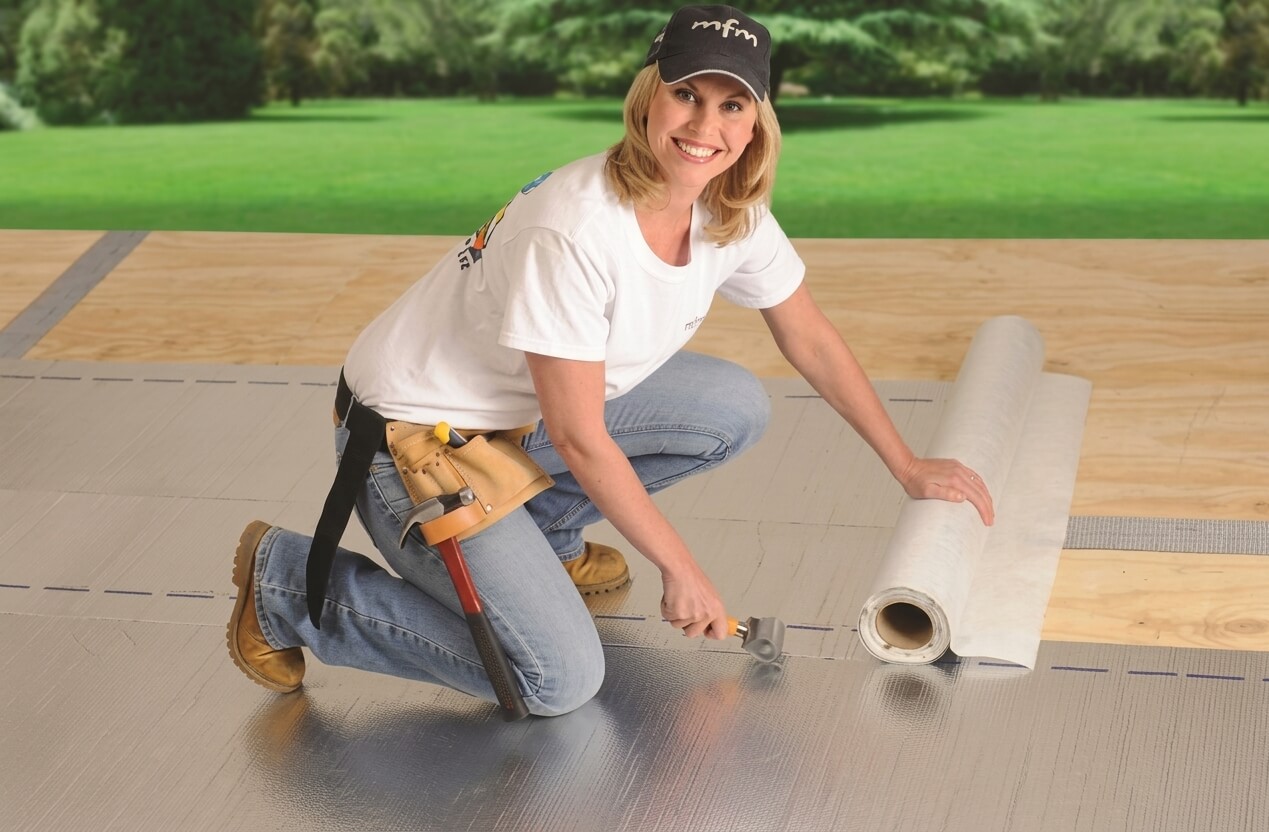
A self-adhesive aluminium-faced membrane in rolls: peel the backing off, stick it down, overlap 3 in along the sides and 6 in at the ends, then roll it down hard. It's reflective, so it keeps the shed cooler in strong sun. MFM says never to stick it straight onto tongue-and-groove plank boards, and it will not warrant it on boards that still hold tree resin, which is exactly the kit roof. On a SolidBuild shed it goes over a sheet of plywood or OSB laid on the boards and primed with MFM's primer (or over a nailed, primed base sheet). Minimum slope ½:12, no puddles left standing, and don't walk on it once it's down. Boards and air both above 55 °F when you lay it. It won't let moisture through (it's a vapour barrier), so keep the roof ventilated.
- Fits
- every model, over plywood/OSB
- Minimum
- ½:12
- Guide price
- $2.00 / sq ft
- Lifespan
- 10-year warranty
- DIY
- Easy
EPDM rubber and TPO / PVC membranes
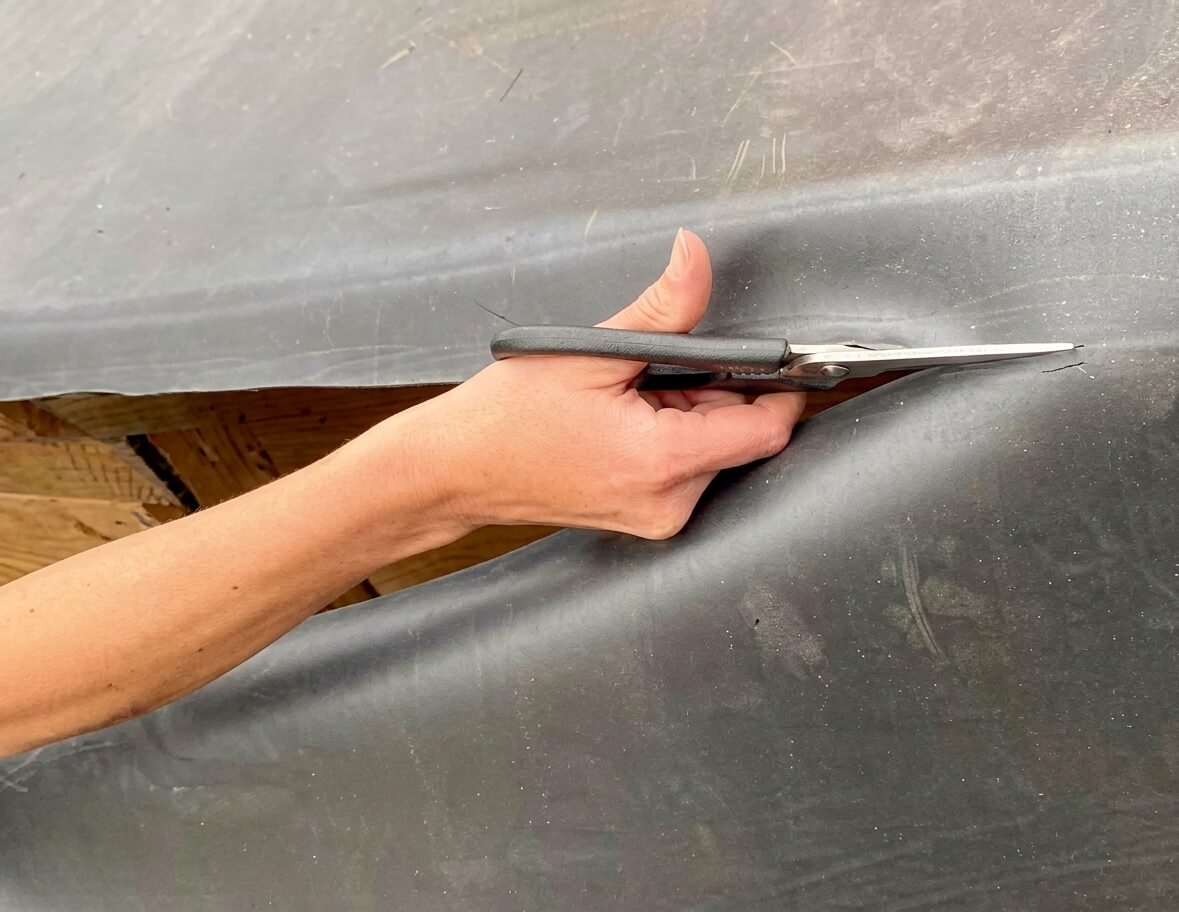
One big sheet of rubber (EPDM, black) or plastic (TPO or PVC, usually white and reflective), glued down with the manufacturer's adhesive, the edges finished with trim or a termination bar, the metal strip that clamps the edge down. Rated to ¼:12, so this is the covering made for Moderna and Solana, and a fine choice on Astoria, California and Washington. EPDM stays flexible in hard frost and copes with roof heat; our FAQ calls it the most popular DIY choice for flat roofs.
Buy the sheet by the roof's two sides, not by its area, and add 12 in overall to each dimension, about 6 in of spare at each edge to fold down and trim, rounded up to the next half foot. The common 10 × 20 ft DIY sheet is 200 sq ft but only 10 ft wide, and every SolidBuild modern roof is wider than that: buy a wider sheet from a roofing supplier, or plan one seam joined with the manufacturer's seam tape.
| Model | Roof size (our records) | Sheet, at least (roof + 12 in on each dimension) |
|---|---|---|
| Moderna | 11 ft ½ in × 11 ft ½ in | 12½ × 12½ ft |
| Solana | 14 ft 1 in × 10 ft 6 in | 15½ × 12 ft |
| California | 12 ft 10½ in × 12 ft 10½ in | 14 × 14 ft |
| Astoria | 11 ft 9 in × 15 ft 9 in | 13 × 17 ft |
| Washington | 17 ft 5 in × 16 ft 4 in | 18½ × 17½ ft |
- Fits
- Every model
- Minimum
- ¼:12
- Guide price
- $3.00 / sq ft (calculator rate; September 2026 California retail: 60-mil membrane about $1.47 and low-VOC adhesive about $1.33 per sq ft, plus the edge turn-downs)
- Lifespan
- 20–30 years
- DIY
- Easy to moderate
Metal panels, screw-down
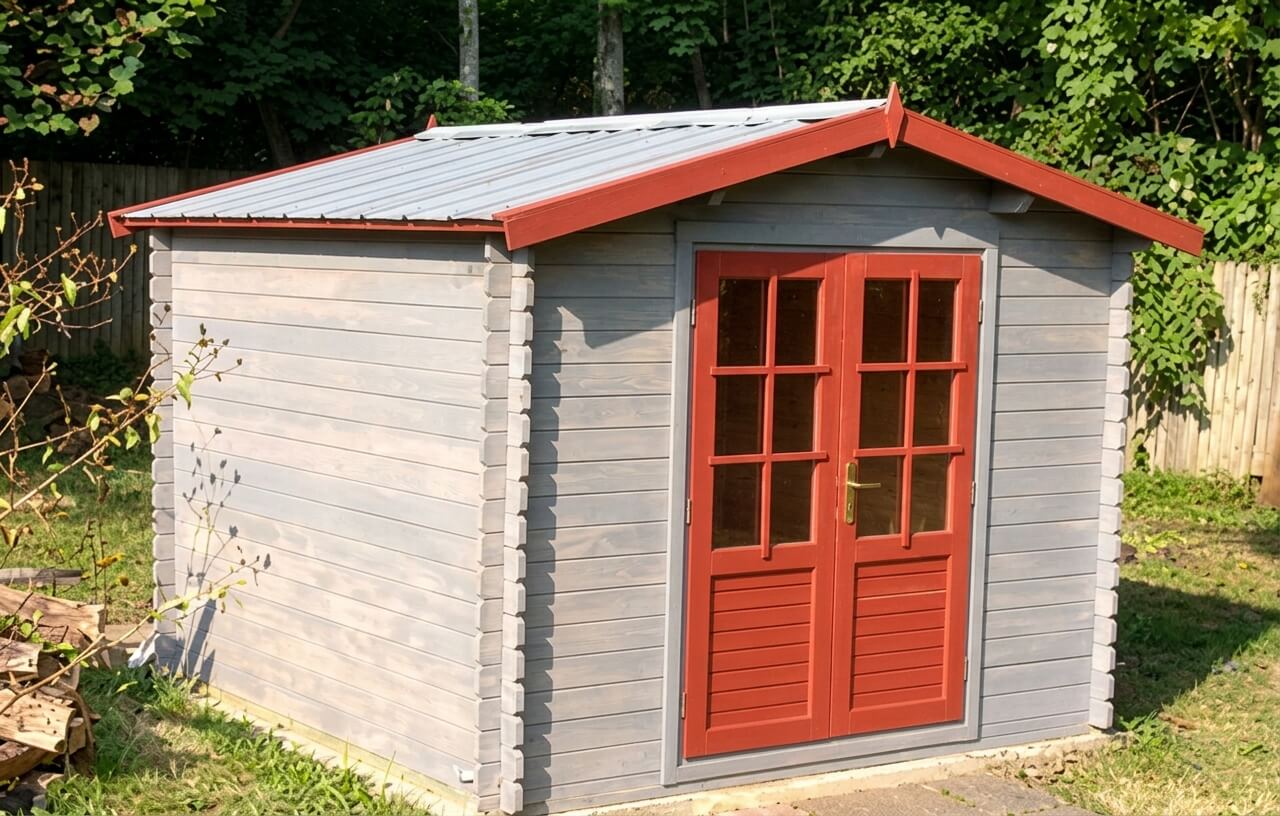
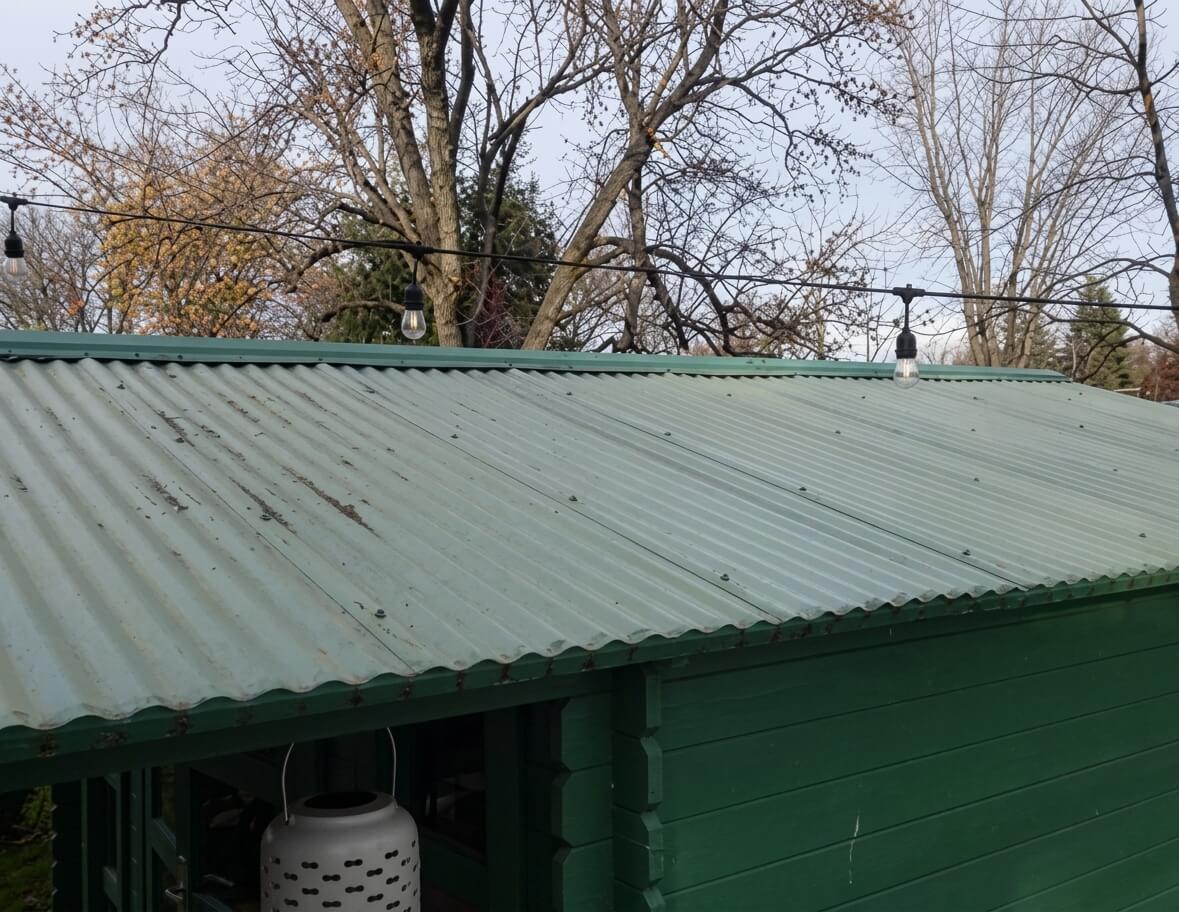
Corrugated or ribbed steel panels, screwed down through the face with rubber-washered screws, each panel overlapping the next by one rib. They last a long time and come in plenty of colours. The rubber washers under the screws are the part that ages, so look them over every couple of years and replace any that have cracked. Panels simply overlapped need 3:12 by code, so any panel suits the gable models. Below that the code allows ½:12 as long as you seal the overlaps, and each panel manufacturer sets its own recommended minimum: Metal Sales rates its R-panel and PBR profiles to 1:12 with sealing tape (butyl tape) in the side overlaps and short screws through them (stitch screws), while its Classic Rib, the thin panel sold by the sheet at hardware stores, is rated 3:12. So on Astoria, California and Washington, buy a panel whose label says 1:12, seal every side overlap and screw through it. Customers have used screw-down metal on Moderna and Solana too and it has worked, with every overlap sealed and screwed. Just go in knowing those two are below the 1:12 the manufacturers recommend, so the washers matter more here than anywhere: check them every couple of years and replace the cracked ones.
- Fits
- 4:12 and 3:12: any panel · 1:12: a 1:12-rated panel with the overlaps sealed · ½:12: overlaps sealed and the washers checked every couple of years
- Minimum
- 3:12 plain · ½:12 sealed (code) · 1:12 by panel manufacturer
- Guide price
- $2.00 / sq ft
- Lifespan
- 20–60 years
- DIY
- Moderate
Metal, standing seam
Panels joined by raised seams with no screws showing, the premium metal roof, often quoted at 80 years. Some clip-together panels are rated to 1:12 over a solid surface (Metal Sales Vertical Seam); others need 3:12 (MBCI LokSeam), so read the label. The kind that's crimped shut with a seaming tool (mechanically seamed, if you're searching for it) goes down to ½:12, which makes it the standing-seam choice for Moderna and Solana, and a job for a roofer, since that tool is the whole trick.
- Fits
- 4:12, 3:12; 1:12 with a 1:12-rated clip-together panel; ½:12 crimped seam
- Minimum
- ¼:12 code · 1:12 clip-together · ½:12 crimped seam
- Guide price
- $5.00 / sq ft
- Lifespan
- about 80 years
- DIY
- Clip-together yes; crimped seam no
Clear polycarbonate or PVC panels
Corrugated see-through panels that let daylight in. They screw down onto shaped foam fillers (closure strips), with no underlayment underneath, it would block the light. Manufacturers want 1 to 1½ in of rise per foot (Onduline Tuftex 1:12; Palram Suntuf and Palruf 1½:12, and in heavy-snow areas Tuftex asks for up to 3:12), so they suit the gable models and, with a 1:12-rated product, the Astoria, California and Washington. The Bristhol in the photo has several roof boards left out to let more light in. Talk to us before you copy that, those boards are what carry the snow.
- Fits
- 4:12, 3:12; 1:12 with a 1:12 product
- Minimum
- 1:12 to 1½:12 by manufacturer
- Guide price
- $2.00 / sq ft
- Lifespan
- varies by product
- DIY
- Easy
Section 6
Underlayment: the layer nobody sees
Underlayment is the roll of felt (or synthetic sheet) that goes between the roof boards and the covering. Under shingles you can't skip it, and on a 3:12 roof it's the layer that keeps you dry. The code gives you two ways to do it:
Left: the standard method for Shiba, Myrtle and Whales. Right: the low-slope method for Gardener, Optima, Bristhol, Aspen and Dakota, and our suggestion for the 4:12 three as well. Both from the International Residential Code, Table R905.1.1(2), 2021 edition; the 2024 edition and Owens Corning describe the overlap as "half the sheet width plus 1–2 in", so if you overlap 20 in you satisfy every version. A synthetic underlayment overlapped the same way counts too.
Option 1: two layers of felt
Start with a 19-in-wide strip along the eave, then lay full 36-in sheets so each one covers the top 19 in of the one below (17 in shows; make it 20 in if your shingle wrapper says so). Overlap 4 in at the ends and stagger those joints. #15 felt is fine under the model code, though some towns don't allow it and #30 is thicker and tears less. Even overlapped like this, a 432 sq ft roll of #15 still covers about 204 sq ft, so one roll does both layers on every model except Dakota (with 20-in overlaps, a Bristhol needs a second roll). With #30, which comes in 216 sq ft rolls, plan one extra roll on every model except the Shiba. Priced by the square foot, the way the calculator does it, the second layer is about $13 on a Shiba and $29 on a Bristhol; bought as whole rolls it is usually nothing extra with #15 and one more $35 roll with #30.
Two cases where this doesn't hold. CertainTeed accepts two felt layers only where snow and ice are not expected, with CertainTeed shingles in a winter climate, use Option 2. And the code's ice-barrier rule for buildings in ice-dam areas (an ice-and-water strip from the eave to 24 in past the wall line) exempts unheated sheds but can apply to one that is heated or cooled, Option 2 covers it either way.
Option 2: ice-and-water membrane over the whole roof
A stick-down rubberised sheet (Owens Corning WeatherLock, GAF WeatherWatch or StormGuard, Grace Ice & Water Shield, Henry Blueskin and others, look for ASTM D1970 on the label). Peel the backing, stick it down, overlap 3 in, no nails. It seals itself around the shingle nails, which is why several manufacturers recommend it (CertainTeed requires it wherever snow or ice occur; IKO and Atlas recommend it; the others accept either option) and why we do. A 200 sq ft roll covers about 183 sq ft once you allow for the overlaps: one roll for Shiba, Gardener, Aspen, Myrtle and Whales; two to be safe on Optima and Bristhol (one roll covers their bare roof but not the 10 % waste margin); always two on Dakota. Expect about $77–116 a roll for the cheaper ones (Home Depot, September 2026) and about $186–293 for the big-name brands. This is the option we recommend if the extra $50–120 fits your budget (about $165 on a Dakota). One $110 roll covers every model except Optima, Bristhol and Dakota, and you won't need the $35 roll of felt.
And under the other coverings? Under metal and roll roofing the code defers to the manufacturer's instructions, normally one layer of felt, synthetic sheet or self-adhered membrane. Clear panels are the exception: no underlayment, or the light would not get through; the panel manufacturer's foam fillers and sealant do that job. Under a glued membrane (EPDM, TPO/PVC) there's no underlayment at all; the membrane is that layer. Whatever you use, start with roof boards that are clean and dry.
Drip edge
An L-shaped metal strip along the roof edges that throws water clear of the boards instead of letting it run back behind the fascia. It's cheap, about $1.50 a foot around the roof, so $48–90 for a shed, and the code requires it under shingles. Along the eaves it goes under the underlayment; along the rakes it goes over it. Nail it every 8–12 in, overlap the joints 2 in, and let the lip hang at least ¼ in below the boards with the flat leg sitting 2 in onto the roof. It also changes when you fit the fascia boards, see section 9.
Section 7
How to shingle a gable shed (4:12 and 3:12 models)
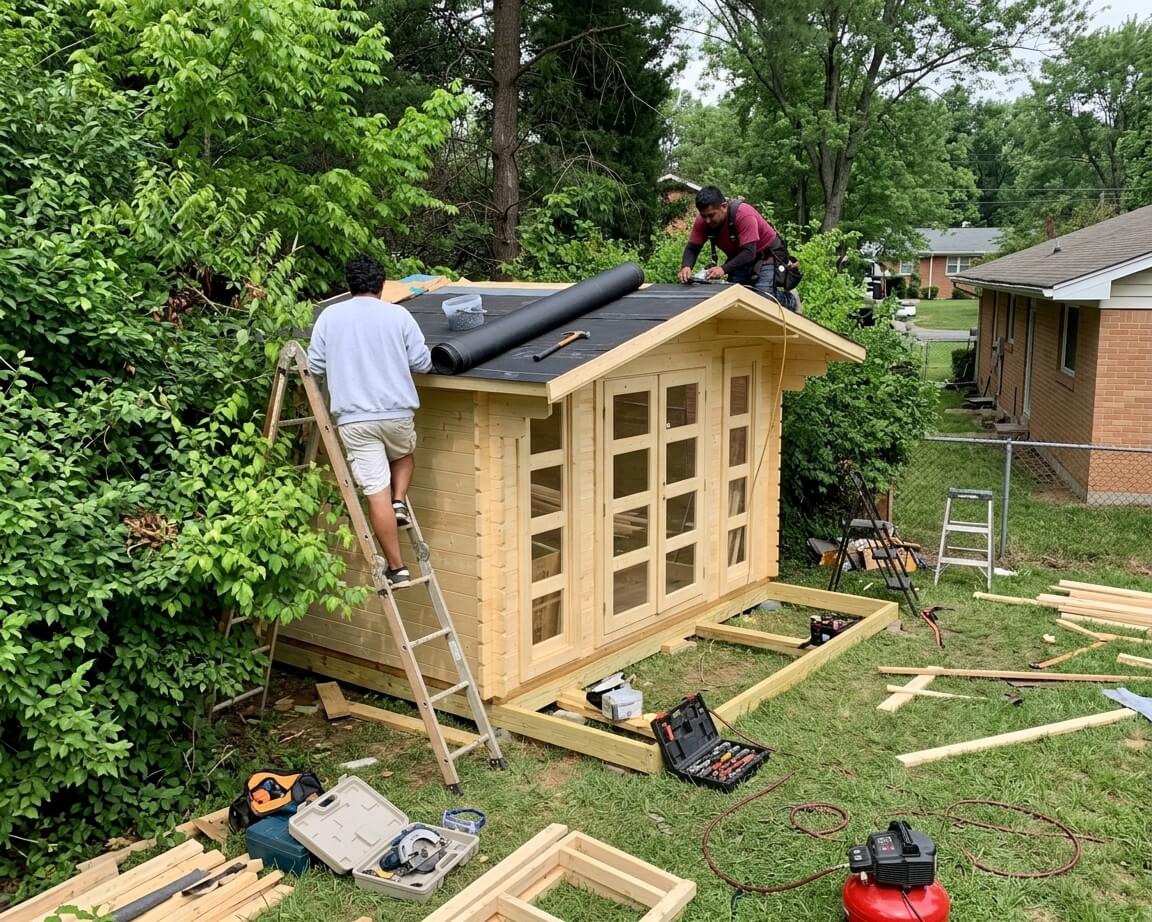
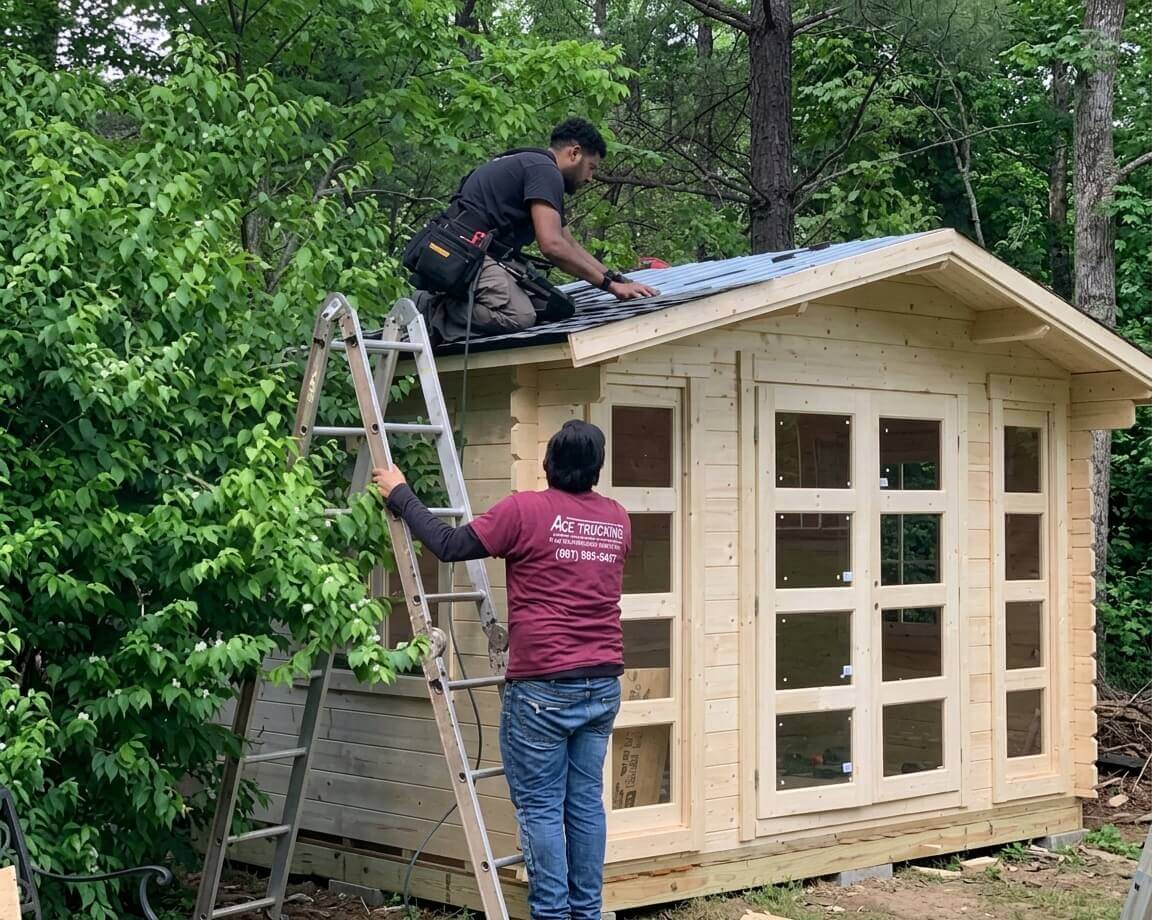
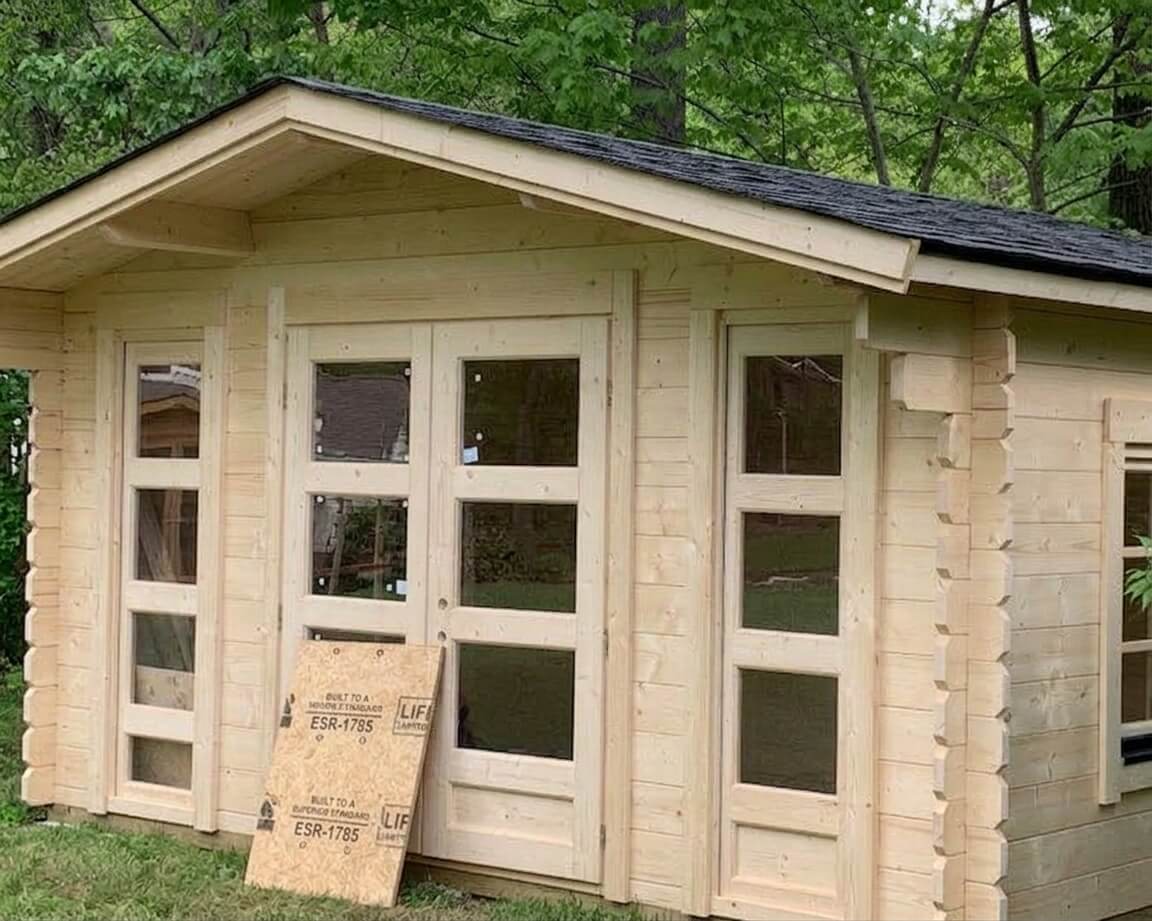
What you'll need: shingles for the roof area plus 10 % (the calculator does this for you), starter strip (or cut shingles), ridge caps, underlayment (two layers or an ice-and-water roll on the 3:12 models; one layer, or the same, on the 4:12 models), drip edge for the perimeter, roofing nails (1 in for three-tab on the bare boards; for architectural shingles measure two layers of shingle plus the ¾ in boards against the nail length, and add an OSB or plywood layer with 1¼ in nails if the nail is longer), a utility knife with hook blades, a chalk line, a tape measure, a hammer or a roofing nailer, and a ladder that reaches past the eave. Two people and one dry day.
Safety tip. Have someone hold the ladder, stand it 3 ft past the eave, and stay off the roof in rain, frost or wind. Fresh ice-and-water membrane and any wet membrane are slippery; nearly every DIY roofing injury is a fall.
Build the shed first, then choose when the fascia goes on
Roofing is the last job on the building. Finish the walls, set the roof beams and nail down every roof board, including the last ones at the peak, so the two slopes meet along the ridge with no gap. Then decide when the fascia boards go on, because that depends on your roofing. If you want the fascia to hide the edge of the roofing and you are not using drip edge, leave the front and back fascia off until the roofing is done; that is the assembly manual's tip. If you are using drip edge, fit the front and back fascia first so the drip edge can sit over their top edge, and leave the decorative diamond off, or fit it last, so it is not in the drip edge's way. That one is from the manual too.
Optional: a sheet of OSB or plywood over the boards
It gives you a flat, solid surface to nail into and keeps the nail points out of sight. The only catch is the weight, which comes out of the snow-load rating on your model's spec card.
Drip edge along the eaves
Nail it every 8–12 in, overlap the joints 2 in, and let the lip sit ¼ in below the boards. The rakes (the sloping edges at the gable ends) come later, on top of the underlayment.
Underlayment
On Gardener, Optima, Bristhol, Aspen and Dakota, use the low-slope method: the 19-in starter strip plus 36-in sheets overlapping 19–20 in (section 6), or the ice-and-water membrane over the whole roof, overlapped 3 in and rolled down firmly. On Shiba, Myrtle and Whales one layer overlapped 2 in is the standard, though we'd use the low-slope method there too. Run it over the ridge and at least a foot down the other side. Then the rake drip edge goes on top of it.
The starter row
A starter strip (or shingles with the tabs cut off) along the eave, hanging over the drip edge by whatever the wrapper says (GAF asks for ¼–¾ in), with its glue strip towards the edge. It closes the gaps under the cut-outs in the first row.
Now the shingles, working bottom to top
Snap a chalk line for each row. Lay the first row flush with the starter strip, then work up the roof, leaving as much of each shingle showing as the wrapper says and staggering the joints in the pattern it shows. Put the nails in the marked nail zone, as many per shingle as the wrapper asks for (usually four), and drive them flush. The code wants them to bite ¾ in into the boards, so check your nail length against section 5 before you start. Let the shingles run past the rake and trim them off with a hook blade.
The other side, then the ridge
Do the same on the second slope. Cap the ridge with ridge shingles, each overlapping the last so the open edge faces away from the prevailing wind, and hide the final nails under a dab of roofing cement.
Fascia and trim to finish
Fit or finish the front and back fascia boards and the decorative diamond now if you left them for after the roofing. Check inside for nail points.
How long it takes. Our calculator allows about 3½ hours of roofing work on a Bristhol-sized shed, under 2 on a Shiba and about 5½ on an Optima or Dakota. It works from the floor area, whatever covering you pick. If it's your first roof, plan a full day, and never open up a side you can't close before the rain comes.
Section 8
How to roof a flat or low-slope shed (1:12 and ½:12 models)
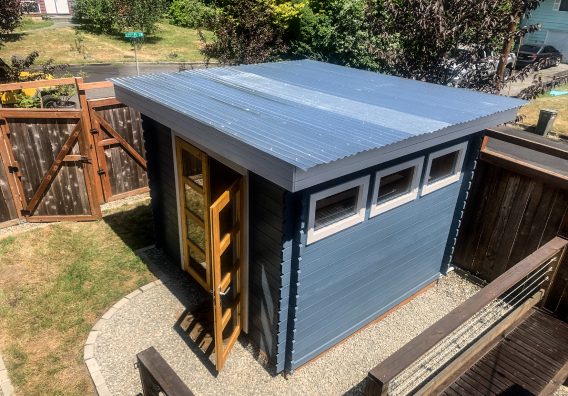
EPDM membrane: the usual choice
What you'll need: one EPDM sheet at least 12 in longer and 12 in wider than the roof (section 5 lists every model's roof size; a Moderna needs 12½ × 12½ ft, and a 10-ft-wide sheet is too narrow for any modern model), the manufacturer's bonding adhesive, a paint roller and a stiff broom, edge trim or a termination bar plus the fascia boards, a sharp knife, and a dry, still day within the temperature range printed on the adhesive can (most want 40 °F and rising). One or two people, half a day. The safety tip above applies here too.
Prepare the boards
Boards nailed flat with no nail heads standing proud, swept clean and dry. Some owners lay a sheet of OSB or plywood first for a smoother base; that's fine, it just adds weight like anything else, which comes out of the snow rating.
Lay it out dry first
Unroll the sheet over the roof, centre it, and leave it in the sun for half an hour so the creases fall out.
Fold half back and glue it down
Fold one half of the sheet back over the other. Roll the adhesive onto the boards, and onto the sheet as well if you're using a contact adhesive, wait for it to go tacky as the can tells you, then lay the sheet back into it, sweeping from the middle outwards with the broom to push the air out. Then do the other half.
Edges and corners
Fold the membrane down over the edge of the roof boards and hold it there with the edge trim or termination bar that came with it, then fold and glue the corners like you're wrapping a parcel. If you want the fascia boards to hide the edge, fit them after this step, over the folded membrane.
Check the water runs off
Water should run to the low edge and drip clear of the shed. Add a drip edge or a gutter on that side if you like, and never let the low edge sit against a wall.
If you'd rather not use EPDM
- Self-adhered 2-ply (every modern model): a nailed base sheet, or a sheet of plywood or OSB primed over the boards. Start the base sheet at the low edge, overlap the sides on the printed line (at least 4 in) and the ends by 6 in, staggering those joints. The cap sheet goes on the same way, with its end overlaps set in a bed of the manufacturer's cement. Press every overlap with a weighted roller and work between 45 and 95 °F. On these gentle slopes you don't need to nail the top edges.
- Peel & Seal (every modern model): over a primed plywood or OSB layer, never straight onto the boards; overlap 3 in along the sides and 6 in at the ends, roll it down hard, and work above 55 °F. Nobody walks on it afterwards.
- Roll roofing (Astoria, California, Washington): a roll whose label says 1:12, or the double-coverage ("concealed-nail") method with the nails hidden and every overlap glued; one layer of underlayment first.
- Screw-down metal: on Astoria, California and Washington an R-panel / PBR-type panel rated 1:12; on Moderna and Solana it has worked for customers with the same care and the gaskets watched. One layer of underlayment. Cut the panels to run from the low edge to the high edge in one piece, start at the end away from the prevailing wind and work across, put sealing tape (butyl tape) in every side overlap with short screws through it (stitch screws), drive the rubber-washered screws where the panel manufacturer's instructions show them, and fit the foam fillers (closure strips) at both ends.
- Standing seam: a clip-together panel rated 1:12 over the solid boards on Astoria, California and Washington; on Moderna and Solana only the crimped-seam kind (rated ½:12), which is a contractor's job.
- Clear panels (Astoria, California, Washington): a product rated 1:12, sitting on the foam fillers (closure strips), with no underlayment.
Section 9
Fascia boards and drip edge: before or after the roofing?
The kit's fascia boards can go on before or after the roofing, the manual leaves that to you. Here are its tips and what they mean in practice:
- Want the fascia to hide the edge of the roofing, and no drip edge? Roof first, then fit the front and back fascia so their top edge sits just above the covering. That's the manual's tip.
- Using drip edge? The manual suggests skipping the decorative diamond on the gable models, or fitting it last, so the drip edge isn't in its way. We'd fit the front and back fascia first so the drip edge can lie over their top edge, then do the roofing.
- Wrapping the felt over the edge of the roof boards? Add the felt first, then put the roof end boards over the wrapped edge to hold it down. That one's from the manual too.
Section 10
Insulating the roof
If you're going to heat or cool the shed, the roof gets insulated above the kit boards, so you keep the tongue-and-groove ceiling on show inside. Two things carry over from the rest of this guide: the underlayment still follows whatever covering you chose, exactly as on an uninsulated roof, and everything you add on top of the boards, lumber, OSB, a second layer of felt, a heavy covering, is weight that comes straight out of the snow-load allowance on your model's spec card. Our insulation guide has the full method; the layers, from the inside out:
Left: the plain build-up. Right: the insulated build-up, the insulation guide allows a 1×2 to 2×4 grid to suit the insulation thickness (the kit fascia still covers up to 2 in), run on edge over the roof beams in snow country; our calculator prices the 2×4 version with 1½ in foam and OSB. With the OSB on top you can use standard roofing nails.
Section 11
Common customer questions
Does the kit come with roofing?
No. The kit gives you the solid tongue-and-groove roof boards (which are your ceiling as well), the fascia boards and, on the gable models, the decorative diamond. The underlayment, drip edge, covering, roofing nails and adhesive you buy locally; most people pick them up the day before they get to the roof.
Can I put shingles on a Moderna, Solana, Washington, Astoria or California?
No, and this is the one place we'd push back hard. All five are under 2:12, and asphalt shingles aren't made or warranted for roofs that flat; they will leak. Use a membrane (EPDM, TPO/PVC), a self-adhered 2-ply or Peel & Seal over a plywood layer, or, on the 1:12 models, a roll rated 1:12 or metal.
Can I shingle a Gardener, Optima, Bristhol, Aspen or Dakota? They look quite flat.
Yes. They're 3:12, which sits in the 2:12-to-4:12 range where shingles are allowed as long as you use the low-slope method: two layers of felt overlapping 19–20 in, or an ice-and-water membrane over the whole roof. Shiba, Myrtle and Whales are 4:12 and take the standard single layer, though we'd still use the low-slope method on them for the extra protection.
Can the roof be made steeper?
No, the slope is what it is; pick the covering to suit the pitch instead.
Which nails do I use with shingles, and will they show inside?
For three-tab shingles, 1 in nails. For architectural shingles, do the math first: two layers of shingle, since every nail goes through the overlap, plus the ¾ in of the boards. If that adds up to less than your nail is long, the point comes out the other side, so lay a sheet of OSB or plywood on top first and nail into that with 1¼ in nails. The only downside is the added weight, which comes out of your snow-load allowance.
Do I need felt or a membrane under the roofing?
Under shingles, metal and roll roofing, yes: felt, a synthetic sheet or a stick-down membrane, and two layers (or ice-and-water) under shingles on the 3:12 models. Under clear panels, no; follow the panel manufacturer's instructions. Under a glued membrane (EPDM, TPO/PVC), no; the membrane is that layer. Under the floor, no; the joists let it breathe.
Can I put a metal roof on any SolidBuild shed?
Screw-down panels: any panel on the gable models. On Astoria, California and Washington, a panel rated 1:12 (R-panel or PBR type) with every side overlap sealed and screwed, not the thin hardware-store rib panel. Customers have done the same on Moderna and Solana and it works, as long as someone keeps an eye on the rubber washers over the years. Standing seam: the gable models, and the 1:12 models with a clip-together panel rated 1:12; on Moderna and Solana only the crimped-seam kind.
What about cedar shingles, or tile?
Cedar shingles are sawn flat and are rated from 3:12, so they go on Shiba, Myrtle and Whales the standard way, and on Gardener, Optima, Bristhol, Aspen and Dakota with less of each shingle showing, which takes about 30 % more shingles. Cedar shakes are split rather than sawn, so they sit thicker and less flat and need 4:12, that is Shiba, Myrtle and Whales only, and a Bristhol or Aspen takes the shingles but not the shakes. Tile and other heavy coverings eat into the snow-load rating, so talk to us before you choose one.
How long does the roof take?
Shingling a Bristhol took Stacey's roofing friends about three hours, and our calculator allows about 3½ hours for a shed that size. If it's your first roof, plan a day for shingles and half a day for a membrane, and never open up a side you can't close before the rain.
Will the roof carry snow?
Each model's spec card lists its roof snow-load rating. The covering only changes that rating through its weight: everything you put above the roof boards (a heavy covering, OSB, insulation) comes out of the allowance. In heavy-snow regions, clear the roof when it piles up.
Section 12
Where these rules come from
- International Residential Code 2021 and 2024, chapter 9: R905.2.2 (asphalt shingles, 2:12 minimum; double underlayment from 2:12 up to 4:12), Table R905.1.1(2) and R905.1.1 Exception 1 (the overlap method and the stick-down alternative), R905.1.2 (ice barrier), R905.2.5 (nail penetration), R905.2.8.5 (drip edge at eaves and rakes), R905.5.2 (roll roofing 1:12), R905.7.2 (wood shingles 3:12), R905.10.2 (metal panels: 3:12 plain, ½:12 with the overlaps sealed, ¼:12 standing seam), R905.11–R905.13 in the 2021 edition (modified bitumen and single-ply membranes, ¼:12; R905.11–R905.12 in 2024), R105.2 (sheds up to 200 sq ft exempt from a permit, not from the code).
- Installation instructions of GAF, Owens Corning, CertainTeed, IKO, Malarkey, TAMKO and Atlas, and the warranties of GAF, Owens Corning, CertainTeed, IKO, Malarkey and TAMKO (asphalt shingles); the Cedar Shake & Shingle Bureau roof manual (cedar); GAF Liberty and CertainTeed Flintlastic SA (2-ply); MFM Peel & Seal application instructions; Metal Sales and MBCI (metal panels); Palram Suntuf/Palruf and Onduline Tuftex (clear panels); the EPDM Roofing Association; ARMA (double-coverage roll roofing).
- SolidBuild assembly manuals (fascia, drip-edge and felt-wrap tips), the SolidBuild insulation guide and FAQ, fifteen years of customer roofs, and our project cost estimator's 2026 rates. Underlayment and membrane prices: Home Depot and Menards, September 2026.
This guide is general information for owner-builders. Roofing products change, so the instructions printed on the product you buy, and your local building department, always come before anything here. If something in it doesn't match what you have in front of you, get in touch and we'll work it out with you.